
Partnership Projects
We collaborate with a number of organisations to support research and public policy around mental health and digital tools.
VoiceIn
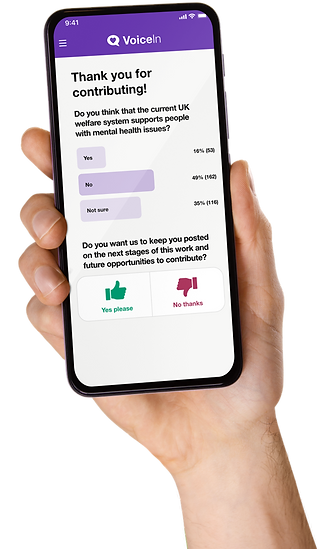
VoiceIn is a project funded by the NIHR GM ARC. It is a digital platform designed to enhance patient and public involvement and engagement (PPIE) in research.
Developed by the Digital Health Software team at the University of Manchester, VoiceIn was co-designed with end users to create a tool that fits seamlessly into modern lifestyles. It works alongside traditional methods of PPIE to broaden the reach and diversity of voices in research.
By helping researchers connect with a wider audience, VoiceIn ensures that all feedback, whether from young people or those with barriers to research participation, is captured and shared with researchers in real time. This approach aims to ensure that every voice is heard, supporting a more inclusive and representative research process.
The platform aims to help public contributors shape the research agenda and to provide researchers with valuable insights to inform their work.
Scan the QR code to download the VoiceIn app

CaFI:Digital
Family Intervention is a talking therapy for people diagnosed with schizophrenia and other forms of psychosis. The therapy is recommended by the National Institute for Health & Care Excellence (NICE).
However, people of Sub-Saharan African and Caribbean origin are rarely offered talking therapies in NHS psychiatric services. People in this group who are diagnosed with psychosis, including those who identify as Black British or Mixed heritage, have worse access to mental health care, treatment, and outcomes than White British people in the UK.

The GM.Digital team was involved in moving CaFI over to a digital platform and creating the CaFi:D digital website, which you can view here. Read more about the results from the pilot study on the NIHR website.
Mental Health Goals Programme
In 2024, the UK Government announced its Mental Health Goals (MHG) programme, which aims to create an innovative alliance between people with mental health conditions – whose views are often not prioritised – and industry – who face unparalleled challenges in mental health research and development – to accelerate precision psychiatry and deliver valuable new treatments that work for those who need them.
The MHG programme is being jointly led by GM.Digital’s director, Professor Kathryn Abel, and Professor Husseini Manji.
In May 2024, the MHG programme invested in DATAMIND – the Hub for Mental Health Informatics Research Development – to support robust data and digital infrastructure.
To find out more information about the MHG programme, visit their website. The MHG programme is the newest addition to the work GM.Digital is supporting and is ongoing.

In September 2021, GM.Digital began supporting the development of DATAMIND 1.0, a Medical Research Council (MRC)-funded hub for Mental Health Informatics Research Development.
Mental health affects nearly everyone at some point in their lives, yet the voices of those most impacted are often underrepresented in research.
People with mental health conditions are frequently excluded from studies or not properly followed up, leaving their needs overlooked or unrecognised.
DATAMIND is transforming mental health research by ensuring that data are findable, accessible, interoperable, and reusable (FAIR).

DATAMIND 2.0 has been funded by the MRC from September 2024 to August 2029. DATAMIND has also partnered with the UK Government’s MHG Programme.
DATAMIND will support the MHG Programme by providing robust data and digital infrastructure. This includes utilising routinely collected data, introducing new types of data for measurement, recruitment, outcomes, and enhancing trial platforms with informatics.
The BAY Trial (Behavioural Activation for Young People with Depression in CAMHS) is a research study evaluating a practical, accessible therapy for teenagers experiencing depression who are referred to specialist Child and Adolescent Mental Health Services (CAMHS).

The BAY Trial is testing Behavioural Activation (BA) — a structured, activity-focused therapy proven effective in adults — to see if it also works for young people. Researchers are evaluating a newly developed 8-session BA programme delivered through a workbook and digital platform using a blended online and face-to-face approach.
Uniquely, the therapy is delivered by non-specialist CAMHS clinicians, making it more scalable within the NHS.
-
It aims to determine whether BA:
-
Reduces depressive symptoms in adolescents
-
Provides good value for money for the NHS
-
Is acceptable to young people, carers, and clinicians
-
Reduces the need for more intensive specialist therapies
The digital platform supporting the trial is being developed by the GM.Digital Research Unit in partnership with the Centre for Health Informatics at the University of Manchester and Greater Manchester Mental Health NHS Foundation Trust.